Publishing isolated blog posts targeting random keywords is a guaranteed way to fail in 2026. Search engines now evaluate domain authority topically. If yo...
Publishing isolated blog posts targeting random keywords is a guaranteed way to fail in 2026. Search engines now evaluate domain authority topically. If you want to rank for "Enterprise SEO," you cannot write one page; you must build an interconnected semantic Topic Cluster.
The Anatomy of a Perfect Topic Cluster
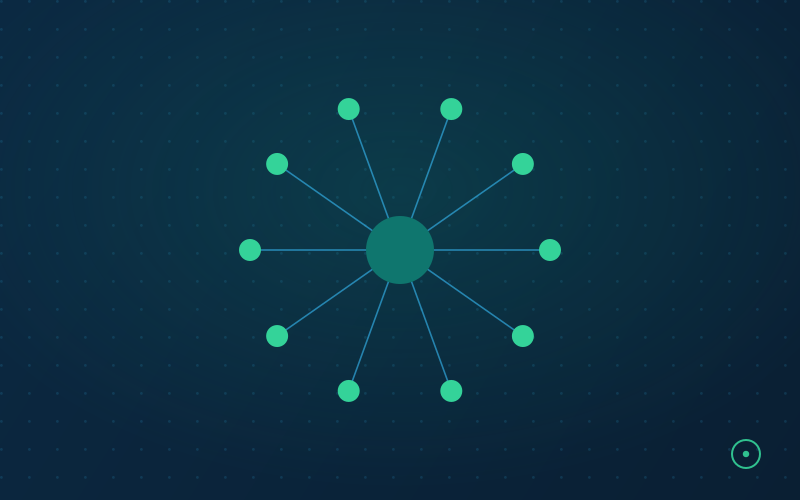
A cluster consists of three elements: The Core Pillar Page (broad topic), the Spoke Pages (long-tail subtopics), and the Internal Hyperlinks (the connective tissue). For a visual breakdown, refer to our On-Page SEO strategies.
Execution Rules for 2026
- Bi-directional Linking: The Pillar must link down to all Spokes, and every Spoke must link back up to the exact Pillar using exact-match anchor text.
- Avoid Cannibalization: Ensure each Spoke targets a distinct intent. Do not write "SEO Tools for Agencies" and "Best Agency SEO Tools" as separate spokes.
- URL Architecture: Keep it flat if possible (e.g.,
/seo-strategyand/seo-strategy-technical-audit) or use subdirectories strategically.
The Sequencing Mistake Most Teams Make
Teams routinely publish 8-10 Spoke pages before the Pillar exists, hoping to "build up" to the cornerstone topic later. This backfires: each Spoke launches with nothing to link up to, so Google has no signal about which page owns the topic. Write and publish the Pillar first, even in a leaner 1,500-word form, then expand it as each Spoke goes live and earns its own rankings.
How to Know a Cluster Is Working
Don't just watch individual keyword rankings — track these three signals at the cluster level:
- Pillar impressions for adjacent queries: If the Pillar starts ranking for terms you never explicitly targeted, that's topical authority compounding.
- Spoke-to-Pillar click-through in Search Console: High internal navigation from Spokes to the Pillar confirms your linking structure is actually being used, not just crawled.
- Time-to-rank on new Spokes: In a mature cluster, new Spoke pages should generally rank faster than a comparable standalone page would, because the Pillar already carries topical trust the new page can borrow from. There's no universal timeline Google publishes for this — if new Spokes are taking just as long to rank as an unrelated new page would, that's a sign the internal linking isn't actually transferring authority the way it should.
Bottom line: a cluster is not a publishing schedule, it is an information architecture decision. Map the Pillar and its Spokes on paper before you write a single sentence — retrofitting internal links onto content that was never designed to connect is far more work than planning the structure up front.