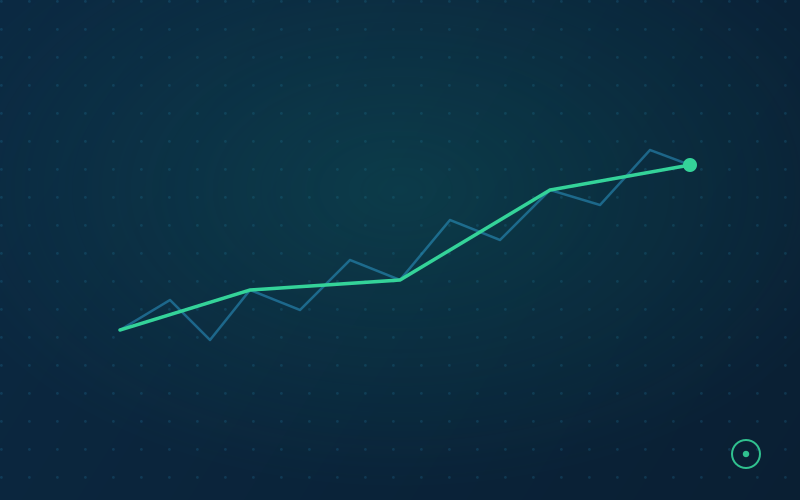
A manual rank check is one biased observation, not a measurement. Here's the statistical case for automated tracking, and how to tell a real ranking trend from ordinary SERP noise.
Manually checking a keyword's ranking — opening an incognito tab, searching the term, scrolling to find your result — feels like a straightforward way to answer "where do we rank." Statistically, it's closer to drawing one card from a shuffled deck and treating it as a description of the whole deck. A single manual check is one observation, taken under one set of conditions, and search results vary by exactly the conditions a manual check doesn't control for.
Why a Manual Check Is a Biased Sample of One
Three sources of variance sit between "what you see when you search" and "where you actually rank" in any methodologically meaningful sense.
- Personalization and account history. Even in a logged-out or incognito session, signals tied to your device, browser fingerprint, and recent search history can influence what you're shown. You're not observing a neutral result — you're observing the result Google's ranking system produced for approximately-you.
- Location. Results for anything with local intent, and plenty of queries without obvious local intent, vary by the geographic location Google infers for the request. Checking from your office and checking from a target market can produce genuinely different SERPs for the identical query string.
- Ordinary SERP volatility. Search results are not static between refreshes. Google runs a continuous stream of ranking experiments and updates, and a meaningful share of day-to-day position movement for any given keyword is noise — short-lived fluctuation that reverses on its own — rather than a durable change caused by anything you did or didn't do.
None of this means manual checks are useless — they're fine for a quick spot-check of a specific claim. It means a single manual check is the wrong instrument for answering "is our ranking actually trending up or down," because that question requires holding the measurement conditions constant across repeated observations, which is precisely what ad hoc manual checking doesn't do.
Telling Signal From Noise in a Ranking Change
The practical question isn't "did our position change" — positions change constantly at the margins for almost every tracked keyword. The question is whether a given change is large enough and sustained enough to be worth reacting to. A move from position 8 to position 6 that reverses within three days is very likely volatility. The same move, held for three consecutive weeks across a stable measurement setup, is a different kind of signal. Distinguishing the two requires exactly what a manual, ad hoc check can't provide: a consistent time series, checked under fixed conditions, long enough to see whether a movement persists.
This is the same logic that applies to interpreting any noisy metric: one point tells you almost nothing; a trend line, sampled consistently, tells you whether what you're seeing is real. Treat a single day's rank check the way you'd treat a single day's stock price — interesting, not diagnostic.
What a Controlled Measurement Actually Requires
To get a trend line worth trusting, three conditions need to hold across every check: the same location setting each time (not wherever you happen to be sitting), the same device/desktop-vs-mobile setting each time (rankings frequently differ between the two, and mixing them into one series muddies the read), and a fixed, regular checking interval rather than checking whenever you remember to. None of these are hard requirements individually — they're just the kind of discipline that's nearly impossible to maintain by hand across more than a handful of keywords, which is exactly why rank tracking gets automated rather than done manually at any real scale.
What to Track Once It's Automated
Position by itself is a thin metric. The more useful setup pairs position with the target URL actually ranking (a keyword can shift which of your own pages ranks for it, which is itself worth knowing), tracks it consistently across both desktop and mobile since the two frequently diverge, and keeps enough history to distinguish a genuine multi-week trend from a blip. SearchVitals' Rank Tracker does this automatically on a fixed schedule per site, so the resulting series is directly comparable week over week instead of being contaminated by inconsistent check timing or conditions.
Tracking Tells You What Happened. It Doesn't Tell You What to Target Next.
A clean ranking trend line answers "is this keyword moving." It doesn't answer "which keywords are actually worth the effort of targeting in the first place" — that's a separate, upstream question about opportunity sizing rather than measurement, and it's worth treating as its own step. We cover that in our piece on keyword research for technical SEOs, which is the natural companion to this one: research first to decide what's worth targeting, then track to see whether the targeting worked. For the broader context of how ranking and link signals interact, see our Backlinks & Rankings guide.